
For Want of a Nail
How to avoid small mistakes before they turn into 7-figure problems
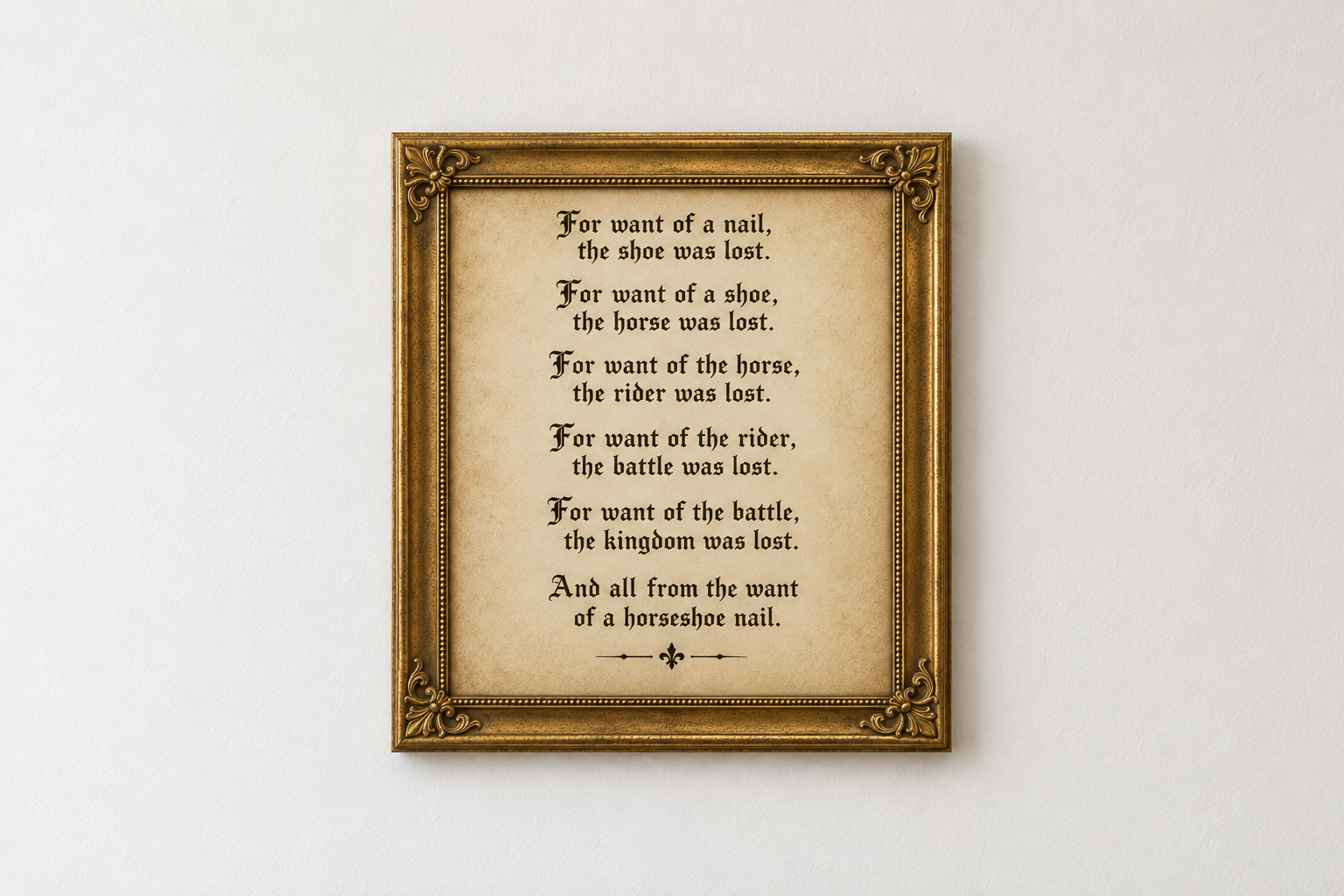
There is a reason why the 700-year-old cautionary tale “For Want of a Nail” has stood the test of time. We have all seen tiny mistakes or problems cascade into much bigger catastrophes. A fallen rock or small animal can trigger a massive avalanche if the snowpack is already unstable. In 1999, the Mars Climate Orbiter was destroyed in Mars’ atmosphere due to a small mismatch between measurement systems. And in 1972, a boy named Alexander woke up with gum in his hair and ended up having a terrible, horrible, no good, very bad day.
It’s very unusual for people to trace back failures to their most granular root cause, unless there is a catastrophic event that demands it. In many cases, however, failures occur because of the culture and context in which they are permitted to happen. Small problems are more likely to become big problems if the organizations themselves are porous and vulnerable. The fabled kingdom from the nursery rhyme didn’t fall because of one nail. It fell because it was the kind of kingdom where small things were beneath notice, and something as basic as enough nails couldn’t be counted on.
In other words, there is a difference between human error and a culture of mistakes. The point of the poem isn’t to vilify this poor blacksmith who ran out of nails. It's to avoid having a culture where the blacksmith shouts, 'We need more nails!' and everyone ignores him, because small issues and mistakes are dismissed as either unavoidable or too insignificant to matter.
“Trifles make perfection, and perfection is no trifle”
Fun fact: the original version of “For Want of a Nail” was written by a German poet named Friedank around the year 1230 A.D. Below is its English translation. Can you tell what the difference is?
A nail keeps a shoe,
A shoe a horse,
A horse a man,
A man a castle,
Who knows how to fight.
That’s right. The early version did not focus on what a kingdom stood to lose, but everything it had to gain. It was a positive story of a culture of excellence, where quality and supply were never in question. Even in the 13th century, it seems, no one did metallurgy like the Germans.
Rather than thinking of culture or excellence as something handed down from the top, it may be better to see it as something built up from the smallest details. When an organization treats the minutiae not as trivial but as critical to its success, that care shapes how everyone works, at every level.
“The devil is in the details.” But so are your angels.
Who is the quality assurance person on your team that is demanding improvements that everyone else rolls their eyes at? Is it Ned? Is his name Ned?
Ned might just be the hero of your story, the person whose attention to detail steers the ship away from the iceberg. People like Ned are the ones sounding the alarm: “Hey, I really think this small thing over here is going to become a major issue.” Whether it does depends on the health of the organization. In a resilient company, a small error stays small. In a fragile one, it can crack the foundation.
"Take care of the pence, and the pounds will take care of themselves."
For those who need convincing, we have created an ROI calculator specific to the industries Larabee serves that demonstrate all there is to lose — or gain, depending on how you see it — when companies decide for themselves that mediocrity is no longer tolerable.
